Neural Network Implementation from Scratch
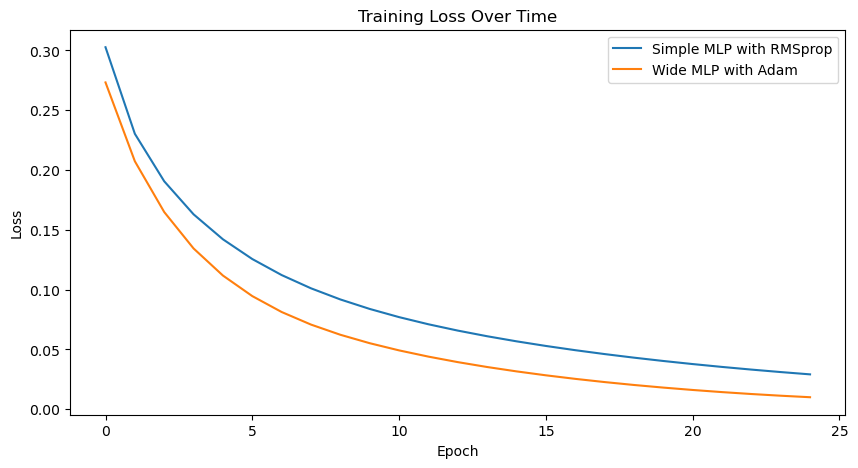
Overview
This project implements a fully-functional deep neural network from scratch using only NumPy. The goal was to understand the fundamental mathematics behind neural networks by implementing forward propagation, backpropagation, and various optimization algorithms.
Features
- Layers: Dense (fully connected) layers
- Activation Functions: ReLU, Sigmoid, Softmax, Identity
- Loss Functions: MSE, Cross-Entropy
- Optimizers: SGD with Momentum, Nesterov AGD, RMSprop, Adam
- Sequential Model API: Easy model construction and training
Installation
Clone the repository and install the package:
git clone https://github.com/theoteske/basic-neural-net.git
cd basic-neural-net
pip install -e .
To run the examples, install additional dependencies:
pip install -e ".[examples]"
Usage
Basic example of creating and training a model:
from basic_neural_net import Sequential
from basic_neural_net import layers, activations, losses, optimizers

# Create model
model = Sequential()
model.add(layers.InputLayer(input_shape=784))
model.add(layers.Dense(784, 128, activation=activations.Sigmoid))
model.add(layers.Dense(128, 10, activation=activations.Softmax))

# Train model
model.train(
    X_train,
    y_train,
    epochs=10,
    learning_rate=0.001,
    batch_size=32,
    loss=losses.CrossEntropy
)

# Make predictions
predictions = model.predict(X_test)
Examples
The repository includes a Jupyter notebook demonstrating MNIST digit classification:
cd examples
jupyter notebook mnist_example.ipynb
Requirements
- Python 3.7+
- NumPy
- SciPy
Optional dependencies for examples:
- TensorFlow (for MNIST dataset)
- Matplotlib (for visualizations)
- Jupyter (for notebooks)